
Privacy-First Face Analysis Powered by Local AI
This article explains the technical and ethical principles behind FaceInsight’s approach to facial analysis. No medical or legal claims are made.
The Question Nobody Asks — But Everyone Should
Every time you use a face-based app, one thing happens before any result appears on your screen: your face goes somewhere.
To a server. To a database. Through a network connection to infrastructure you have never seen, owned by a company whose data practices you have likely never read in full. Your facial geometry — one of the most uniquely identifying datasets that exists — travels across the internet and lands in a system designed primarily to serve the company’s interests, not yours.
Most people don’t think about this. The result appears quickly, the experience feels seamless, and the transaction — your biometric data in exchange for a moment of entertainment or insight — happens invisibly.
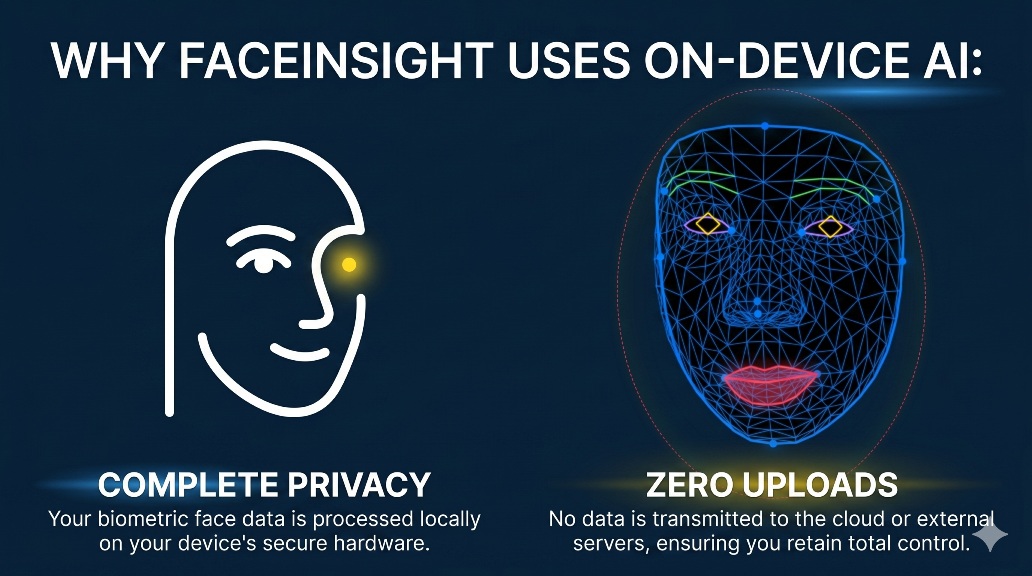
FaceInsight was built on a different premise entirely. Your face never leaves your device. Not a compressed version. Not an anonymized hash. Nothing. The entire analysis happens locally, in your browser, in real time — and when you close the tab, there is nothing left to delete because nothing was ever stored.
This article explains exactly how that works, why it matters, and what it means for you as a user.
The Problem With “Normal” Face Apps
To understand why on-device processing is significant, it helps to understand what the alternative actually involves.
The standard model: send, analyze, return
Most face-based applications — whether they offer readings, filters, aging simulations, or beauty scores — follow the same basic architecture:
- You take a photo or enable your camera
- The image (or a video frame) is transmitted to a remote server
- The server runs the analysis using its processing power
- The result is sent back to your device and displayed
This model exists for a straightforward reason: it’s easier and cheaper to build. Running complex AI models requires significant computing power, and until recently, most devices didn’t have enough of it to handle sophisticated facial analysis locally. So companies built server-side infrastructure and routed user data through it.
The problem is everything that happens in steps 1 through 3 that users never see.
What happens to your facial data?
When your image reaches a company’s server, you have essentially lost control of it. Depending on the company’s privacy policy — and crucially, depending on how carefully you read that policy — your facial data may be:
- Stored indefinitely to improve AI model training
- Shared with third parties including analytics providers, advertising networks, or data brokers
- Used to create a biometric profile linked to your account, email address, or device ID
- Subject to government requests in jurisdictions where the company operates
- Vulnerable to data breaches — a server that holds millions of facial scans is a high-value target
Facial geometry is not like a password. You cannot change it. If your facial data is compromised in a breach, or sold to a party whose interests don’t align with yours, there is no recovery action available. The data is out there, permanently.
This is not a hypothetical concern. Multiple major tech companies have faced significant legal action in recent years over the collection and use of facial recognition data — including billion-dollar settlements related to biometric data laws in various jurisdictions.
FaceInsight’s Approach: Everything Stays on Your Device
FaceInsight’s architecture makes a fundamentally different choice at every decision point.
No image upload. Ever.
When you use any FaceInsight tool, your camera feed is processed entirely within your browser using JavaScript. The video stream from your camera never leaves your device — it is not transmitted over a network connection, not sent to a server, and not stored anywhere. The pixel data that makes up your face exists only in your device’s memory, for the duration of your session.
When you close the browser tab, that data is gone. There is no record of it anywhere.
No account required
FaceInsight requires no registration, no email address, and no account creation. This means there is no user profile to attach your facial data to, even if data collection were happening — which it isn’t. The anonymity is structural, not just promised.
No cookies tracking your face
Standard analytics cookies may be used for basic site performance measurement — how many visitors, which pages are popular — but these contain no facial data. They cannot, because no facial data ever reaches the FaceInsight servers to be associated with a cookie.
The Technology: How MediaPipe Makes This Possible
FaceInsight’s on-device processing is powered by MediaPipe — an open-source framework developed by Google that enables sophisticated machine learning tasks to run directly on a device’s processor without requiring a server connection.
What MediaPipe does
MediaPipe’s face landmark detection model identifies 478 distinct points on the human face in real time. These points — called landmarks — correspond to specific anatomical locations: the corners of the eyes, the tip of the nose, the edges of the lips, the contours of the cheekbones, the arch of the brows, and dozens more precise locations across every facial region.
From these 478 coordinates, FaceInsight’s interpretation layer calculates the proportional relationships between features — the ratio of the Three Courts, the relative fullness of the nose tip, the symmetry of the brow placement, the balance of the Five Mountains — and maps these measurements onto the classical frameworks of Mian Xiang.
The result is a reading grounded in precise geometric measurement, interpreted through the lens of classical Chinese physiognomy.
Why 478 landmarks matters
To put this in context: early face detection systems worked with as few as 5 to 68 landmarks. The jump to 478 represents a qualitative shift in what’s possible. At 478 points, the model captures not just the broad shape of the face but its fine texture — the subtle curve of the nose bridge, the precise arc of the brow tail, the exact proportional relationship between the width of the mouth and the distance between the eyes.
This level of resolution allows FaceInsight to make the nuanced distinctions that classical face reading requires. The difference between a slightly high arch and a dramatically high arch in the brows — two configurations with meaningfully different readings — is detectable at 478 landmarks in a way it simply isn’t at 68.
Running on your device
MediaPipe is specifically designed to run efficiently on standard consumer hardware — the processors in everyday smartphones, laptops, and desktop computers. It uses WebAssembly and WebGL to access your device’s graphics and processing capability through the browser, without requiring any app installation.
This means the same AI model that would have required a powerful server just a few years ago now runs smoothly on the device in your pocket or on your desk — in real time, with no latency from network transmission, and with complete local privacy.
The Privacy Landscape: Why This Matters More Than Ever
The on-device approach isn’t just a technical preference — it reflects a broader understanding of where facial data sits in the privacy landscape of 2026.
Biometric data is uniquely sensitive
Most personal data — your name, email address, phone number — can be changed if compromised. Biometric data cannot. Your face is permanent in a way that other identifiers are not, which means its exposure carries permanent consequences.
Regulatory frameworks around the world have begun to reflect this. Biometric privacy laws in multiple jurisdictions now impose strict requirements on companies that collect, store, or process facial geometry data — including requirements for explicit informed consent, strict limitations on use, and significant penalties for violations.
By processing everything locally and storing nothing, FaceInsight exists entirely outside this regulatory concern — not through legal maneuvering, but through genuine architectural choice. There is no facial data to regulate because there is no facial data collected.
The AI training economy
One dimension of facial data collection that receives less public attention is its use in AI training. When a company collects facial images from millions of users, those images become a training resource — a dataset used to improve and expand AI model capabilities, often far beyond the scope of the original user interaction.
In simple terms: when you use many face apps, you are not just receiving a service. You are also providing labor — your face, your expressions, your unique biometric signature — that improves systems you will never see and generates value you will never share in.
FaceInsight uses MediaPipe models that were trained by Google on separately assembled datasets. Your face contributes nothing to model training when you use FaceInsight. You receive the service. That’s the complete transaction.
What “On-Device” Means in Practice: Common Questions
Does FaceInsight work offline? Once the page has loaded, the core face analysis functionality works without an active internet connection — because there is no server to connect to for the analysis itself. The initial page load requires connectivity, but the reading itself is fully local.
Is my camera feed being recorded? No. FaceInsight accesses your camera to read real-time landmark positions. It does not record video, capture still images, or store any camera data. The frame-by-frame landmark coordinates are calculated and immediately used for the reading — they are never written to storage of any kind.
Can FaceInsight see my face if I’m not actively using it? No. Camera access is granted only when you are actively using a tool, and it is released when you navigate away from the tool. Your browser controls camera access at the operating system level — you can verify this by watching the camera indicator light on your device.
What data does FaceInsight collect at all? Standard web analytics data — page views, session duration, device type — collected through privacy-respecting analytics tools. No facial data, no biometric information, no personally identifiable information is collected or stored.
Is the MediaPipe model itself private? MediaPipe is an open-source framework with publicly available model weights. The models FaceInsight uses can be inspected by anyone with the technical knowledge to do so. There are no hidden components.
The Bigger Picture: Privacy as a Design Principle
The choice to build FaceInsight on on-device processing wasn’t primarily a marketing decision. It was a values decision.
The question the team asked was simple: what would it look like to build a face reading experience where users never have to trust us with their most sensitive biometric data — where the privacy guarantee is architectural rather than policy-based?
The answer was local processing. Not “we promise not to misuse your data.” Not “we have strong security measures.” Not “we comply with applicable regulations.” But rather: your face never reaches us, so there is nothing to misuse, breach, or comply with.
This is a more honest form of privacy protection than most apps offer. It doesn’t depend on reading a privacy policy, trusting a company’s intentions, or hoping that regulations keep pace with technology. It depends only on physics: data that never travels cannot be intercepted. Data that is never stored cannot be breached.
Try It — Privately
Every tool in the FaceInsight suite operates on these principles. The Three Courts analyzer, the Five Elements reader, the Twelve Palaces mapping, the Facial Aura reading, the Hair Advisor, the Lip Color tool, the Face Outfit recommender — all of them process your face locally, return their results to your screen, and retain nothing.
Explore the full FaceInsight tool suite →
Your face is yours. It should stay that way.
FaceInsight is for personal reflection and entertainment. The on-device processing described in this article is accurate to the best of our technical knowledge at time of publication. For full details, see our Privacy Policy.