
The Nose Knows: What Your Nose Shape Reveals About Wealth and Personality
For entertainment and personal reflection purposes only. Face reading is a traditional Eastern practice, not a medical or scientific tool.
Why the Nose Is the Most Important Feature in Face Reading
In Chinese face reading — known as Mian Xiang (面相) — the nose holds a uniquely powerful position. It is called the “Wealth Palace” (財帛宮), sitting at the very center of your face, governing your financial energy, self-reliance, and personal authority during your most productive years: roughly ages 41 to 50 in the classical age-mapping system.
While eyes capture attention and lips express emotion, the nose quietly tells the story of how you accumulate, protect, and grow your resources — financial, emotional, and energetic.
In this guide, you’ll learn how to identify five common nose types and what each one reveals, according to centuries of Eastern physiognomic tradition.
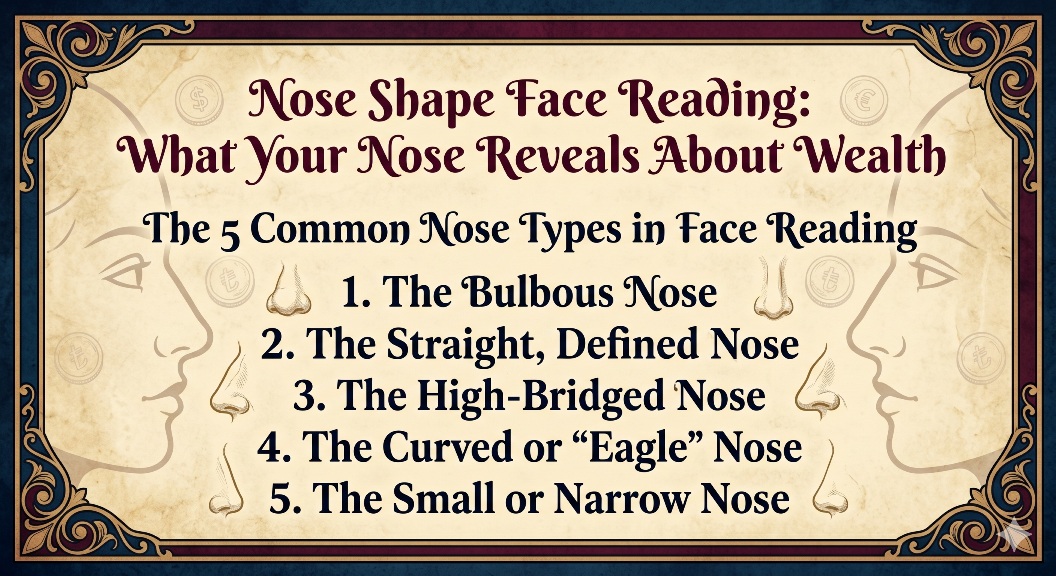
The 5 Common Nose Types in Face Reading
1. The Bulbous Nose (蒜頭鼻 — “Garlic Nose”)
What it looks like: A rounded, fleshy tip with full nostrils. The nose appears soft and wide at the base.
What it reveals: In Mian Xiang, a full, rounded nose tip is one of the strongest indicators of wealth accumulation. The fullness symbolizes the capacity to “hold” resources rather than letting them slip away. People with this nose type are often described as:
- Generous and sociable, with a natural instinct for business
- Practical and grounded in their approach to money
- Good at building long-term financial security through steady effort rather than risk
The broad nostrils suggest an open flow of energy — meaning money comes in, but also flows out. The key for this type is learning when to be generous and when to hold firm.
Famous examples in classical texts: This nose type appears frequently in traditional portraits of prosperous merchants and landowners.
2. The Straight, Defined Nose (正直鼻)
What it looks like: A straight bridge, well-defined tip, and proportionate width — neither too broad nor too narrow.
What it reveals: This is often called the “ideal” nose in classical face reading — not because it is the most beautiful by modern standards, but because it represents balance. A straight nose indicates:
- Strong personal integrity and a clear moral compass
- Steady, reliable income built through discipline and honest effort
- Leadership qualities — others trust this person with responsibility
The straight nose belongs to individuals who rise through merit. They are not flashy, but they are consistent. In traditional Mian Xiang texts, this nose type is associated with professionals, scholars, and administrators.
3. The High-Bridged Nose (高鼻梁)
What it looks like: A prominently elevated bridge, sometimes with a slight curve or peak.
What it reveals: A high nose bridge indicates strong ego, independence, and ambition. This is the nose of someone who charts their own course. Key traits include:
- Strong self-reliance and reluctance to ask for help
- High standards for themselves and others — which can tip into perfectionism
- Excellent capacity for long-term planning and strategy
The shadow side of a very high, sharp bridge is a tendency toward pride or difficulty in collaboration. In relationship readings, Mian Xiang suggests this person needs a partner who respects their independence rather than challenging it.
4. The Curved or “Eagle” Nose (鷹鈎鼻)
What it looks like: A hooked shape where the tip curves downward, sometimes with a noticeable bump on the bridge.
What it reveals: The eagle nose is among the most complex to read. In classical physiognomy it is associated with:
- Exceptional persistence — the ability to pursue goals over years or even decades
- Sharp business instincts and a nose (quite literally) for opportunity
- Strong opinions and a commanding presence
Historically, this nose type was associated with powerful figures in trade and negotiation. However, classical texts also caution that the “hook” can indicate a tendency toward secrecy or difficulty sharing credit with others.
5. The Small or Narrow Nose (小鼻子)
What it looks like: A delicate, petite nose with a narrow bridge and small, close nostrils.
What it reveals: In Mian Xiang, narrow nostrils are read with particular attention. Tight nostrils are traditionally associated with:
- A careful, conservative approach to money — very little waste
- A preference for security over risk; this person builds slowly but surely
- Sensitivity and perceptiveness in social situations
The classical interpretation suggests this type may sometimes limit their own growth through excessive caution. The encouragement from Mian Xiang practitioners is to “widen” one’s energy through acts of generosity and calculated risk-taking.
Beyond the Tip: Other Nose Details That Matter
Nostrils
In face reading, the nostrils represent the “doors” through which financial energy flows.
- Visible nostrils (when viewed from the front): Associated with a generous, outgoing nature — money is shared freely. Can indicate difficulty saving.
- Nostrils that are not visible from the front: Associated with discretion and the ability to accumulate and hold resources.
The Nose Tip
The very tip of the nose — the “Money Seal” (印堂) of the Wealth Palace — is read for its fullness and color. In traditional practice, a fleshy, rounded tip in a healthy, natural skin tone is the classic indicator of robust financial energy. A red or inflamed tip may indicate financial stress in traditional readings, while a very pale tip suggests diminished energy.
The Nose Bridge
A clear, uninterrupted bridge indicates a steady, unbroken career path. Bumps, dips, or lines crossing the bridge are read as disruptions or turning points — not necessarily negative, but significant transitions.
FAQ: Common Questions About Nose Reading
Q: Can plastic surgery change my nose reading? In classical Mian Xiang, this is a nuanced topic. Traditional practitioners generally believe that surgical changes to the external form can shift the energetic expression of a feature — though opinions vary widely. From a personal reflection standpoint, what matters more is the intention and confidence behind how you carry yourself.
Q: What if my nose doesn’t fit neatly into one category? Almost no nose does. Mian Xiang reading is an art of synthesis, not a checklist. Most faces blend multiple types. Read for the most dominant characteristics and trust your intuition about what resonates.
Q: Is this scientifically proven? Face reading is a traditional system of observation and interpretation developed over thousands of years. It is not a scientific discipline in the modern sense, and it should be enjoyed as a tool for self-reflection rather than prediction. Think of it as a mirror, not a map.
Q: Does this mean people with certain nose shapes are “better” than others? Absolutely not. Every nose type in Mian Xiang carries both strengths and challenges. The system is descriptive, not hierarchical. The goal is self-understanding — recognizing your natural tendencies so you can work with them more consciously.
Try Your Own Reading
The best way to apply what you’ve learned here is to explore it firsthand. FaceInsight’s Five Features tool uses technology to analyze your facial landmarks in real time — completely on-device, with no photo uploads required.
Use it alongside this guide to see your features through the lens of classical physiognomy. The tool reads eyes, nose, lips, ears, and eyebrows — giving you a full Five Features reading in seconds.
Face Insight is for personal reflection and entertainment. No claims are made about the scientific validity of physiognomy. All readings should be interpreted with curiosity and self-compassion.