
How to Use AI Face Reading: A Beginner’s Complete Guide to FaceInsight
Face reading is a traditional Eastern practice offered for personal reflection and entertainment. Results are not scientific predictions.
What Is AI Face Reading — And What Can You Expect?
If you’ve ever looked in a mirror and wondered what your features say about you, you’re already thinking like a face reader.
For thousands of years, practitioners of Mian Xiang (面相) — Chinese physiognomy — have studied the face as a map of character, energy, and life patterns. What FaceInsight does is bring this ancient framework into the present: using Google’s MediaPipe AI to detect 478 precise facial landmarks in real time, then interpreting those measurements through the lens of classical face reading tradition.
The result is an experience that feels both modern and timeless — instant, private, and surprisingly thought-provoking.
Before you dive in, here’s exactly what to expect:
- You will not receive a prediction about your future. Face reading is a mirror for self-reflection, not a crystal ball.
- Your photo never leaves your device. All processing happens locally in your browser — nothing is uploaded, stored, or seen by anyone.
- Results are most useful as prompts for self-inquiry, not conclusions to accept uncritically.
- The tools are completely free. No account, no payment, no catch.
With that framing in place, let’s walk through how to use the suite step by step.
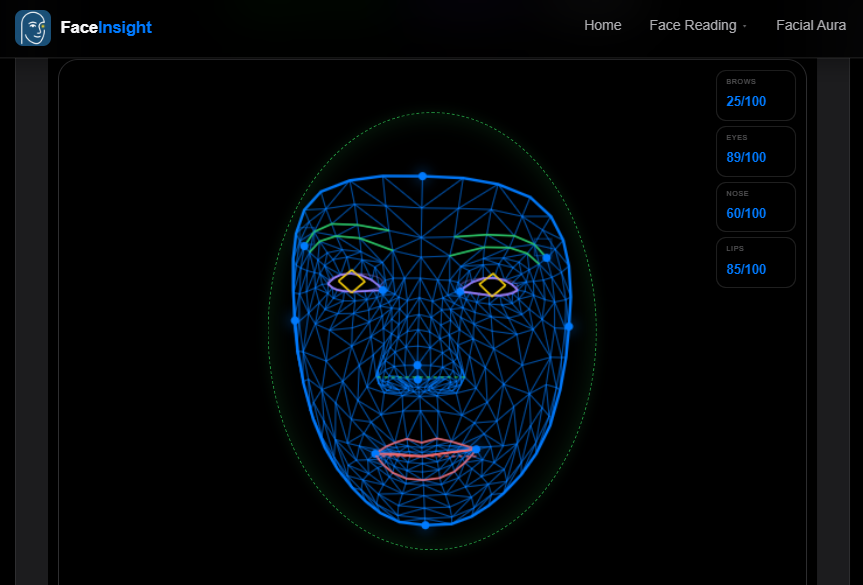
Step 1: Get Your Lighting Right — The Single Most Important Factor
AI face reading relies on detecting the geometry of your face with precision. Poor lighting doesn’t just produce a bad photo — it actively distorts the landmark positions the AI uses to calculate your reading. The difference between a well-lit and poorly-lit session can be dramatic.
The ideal setup:
Natural light, facing a window. This is the gold standard. Soft, even daylight illuminates your features without creating harsh shadows. Position yourself so the light source is directly in front of you — not to the side, not behind you.
What to avoid:
- Overhead lighting (ceiling lights, fluorescent tubes) — creates deep shadows under your eyes, nose, and chin that distort facial proportions
- Backlit conditions (sitting with a window behind you) — your face will appear as a dark silhouette
- Single-source side lighting — dramatically exaggerates asymmetry and can create false readings
- Harsh flash or ring lights pointed directly at your face — flattens features and washes out the contours the AI needs to read
If natural light isn’t available: Use two soft light sources placed at roughly 45-degree angles on either side of your face at eye level. This mimics the balanced, shadowless quality of window light.
A quick lighting test:
Before starting your session, look at your face in the camera preview. You should be able to clearly see:
- The bridge and tip of your nose without harsh shadow
- Both eyes with similar brightness
- Your hairline and chin without being clipped
If any of these are obscured, adjust your position before proceeding.
Step 2: Camera Angle and Expression — Small Details, Big Difference
Once your lighting is set, the next variables are angle and expression. Both affect how the AI interprets your facial proportions.
Camera angle
The ideal angle is straight-on and level — meaning the camera lens is at exactly the same height as your eyes, and you are looking directly into it. Even a slight tilt upward or downward shifts the apparent proportions of your Three Courts (the upper, middle, and lower thirds of your face) and can alter a reading significantly.
Practical tip: If you’re using a laptop, the built-in camera is typically mounted at the top of the screen, which means you’re looking slightly upward — a common source of skewed readings. Prop the laptop on a few books to raise it to eye level, or use a phone camera held at arm’s length, directly in front of your face.
Avoid:
- Tilting your head (even slightly) — introduces asymmetry into measurements
- Looking to the side — the AI reads a frontal face
- Taking photos from below — foreshortens the upper court and exaggerates the lower
Expression
Use a relaxed, neutral expression — not a smile, not a frown. Simply rest your face in its natural state.
This matters because face reading in Mian Xiang tradition reads the structure of your features — the bone and soft tissue beneath — not your momentary emotional expression. Smiling raises the cheeks and changes the apparent shape of the eyes and lower face. A tense jaw alters the lower court readings.
Take a slow breath, let your face relax completely, and then begin your session.
Step 3: Choosing the Right Tool for Your Question
FaceInsight offers nine distinct tools, each rooted in a different classical method. Choosing the right starting point depends on what you’re most curious about.
Here’s a simple guide:
“I want a broad overview of my personality and destiny”
→ Start with Five Elements — this tool identifies your dominant element (Wood, Fire, Earth, Metal, or Water) based on your overall facial type. It’s the best entry point for first-time users because it provides a foundational framework everything else builds on.
“I want to understand my face’s proportions and life chapters”
→ Use Three Courts — this tool measures the ratio of your upper (forehead), middle (nose area), and lower (chin/jaw) facial zones. Each court corresponds to a life phase, and their balance reveals the general shape of your personal journey.
“I want to read specific features — eyes, nose, lips, brows, ears”
→ Use Five Features — the most detailed individual feature analysis, drawing on classical Chinese physiognomy for each of the five major facial elements.
“I want to explore specific life areas — career, wealth, love, health”
→ Use Twelve Palaces — this tool maps twelve distinct facial zones, each governing a specific domain of life. Career, wealth, relationships, travel, health — all have their dedicated palace.
“I want to understand the energy and impression my face projects”
→ Use Facial Aura — this tool reads your facial presence: the qualities of gravitas, openness, warmth, and symmetry that your face communicates before you say a word.
“I want practical style guidance”
→ The three applied tools — Hair Advisor, Lip Color, and Face Outfit — translate your face reading into daily aesthetic decisions, incorporating Five Elements color theory and feng shui principles.
Recommendation for beginners: Run the Five Elements tool first to establish your elemental foundation, then follow with Three Courts for structural context. From there, you’ll have a much richer frame for interpreting the other tools.
Step 4: Interpreting Your Results — The Right Mindset
Your reading has loaded. Now what?
The most common beginner mistake is reading the results as a verdict. They are not. They are a starting point for conversation — with yourself.
Read with curiosity, not judgment
When a reading describes a trait you find unflattering — say, “a tendency toward impatience” or “challenges with financial consistency” — resist the urge to dismiss it or feel discouraged. Instead, sit with the question: Is there any truth here that’s useful to me?
Classical face reading has survived thousands of years not because it perfectly predicts individual outcomes, but because its character frameworks have genuine psychological resonance. The Five Elements personality types, for instance, map closely to models used in modern personality psychology.
Look for patterns across tools
A single reading is a data point. Multiple readings across different tools are a pattern. If the Five Elements tool identifies you as a Wood type and the Five Features reading notes strong, well-defined brows (a Wood characteristic), that convergence is meaningful. If results seem contradictory, you may have a mixed-element face — which is actually quite common and interesting.
Note what surprises you
The most valuable readings are often the ones that highlight something you hadn’t consciously recognized in yourself. Keep a note of one insight from each session. Over time, these accumulate into a genuinely useful self-portrait.
The 5 Most Common Beginner Mistakes
1. Using a screenshot or filtered photo The AI needs a live camera feed or an unedited, well-lit photo. Beauty filters, Snapchat effects, and heavy retouching alter facial geometry and will produce unreliable results.
2. Reading only one feature in isolation The nose cannot be read without considering the eyes, courts, and overall elemental type. Mian Xiang is a holistic system. A feature that looks “weak” in isolation may be balanced by strength elsewhere.
3. Treating results as absolute predictions Face reading describes tendencies and energies, not fixed outcomes. Your choices, environment, and growth matter far more than any reading.
4. Rushing through multiple tools at once It’s tempting to run every tool in one sitting. A more productive approach is one tool per session, with time to reflect between readings.
5. Comparing your results to someone else’s Face reading is a personal practice. Comparing your Wealth Palace readings to a friend’s or partner’s misses the point entirely — and opens the door to unfair judgments. Use these tools for self-understanding, not evaluation of others.
Your First Session: A Suggested Flow
Here is a recommended sequence for your very first FaceInsight session:
Session 1 (10–15 minutes):
- Set up your lighting (facing a window, camera at eye level)
- Open Five Elements — get your foundational element type
- Read the full results, note one trait that resonates and one that surprises you
- Open Three Courts — observe your proportional balance
- Reflect on how the two readings relate to each other
That’s it. Don’t rush further on your first day. Let the readings sit overnight and return with fresh eyes.
Ready to Begin?
The full FaceInsight tool suite is free, on-device, and waiting. No uploads. No account. No data stored. Just you, a good light source, and several thousand years of human observation about what faces reveal.